Skip to Main Content Skip to Footer Content

Commercial Dryer Vent Rerouting in West Michigan

Commercial dryers need a clear exhaust path to remove heat, moisture, and lint. In West Michigan, seasonal cold and moisture can add to problems caused by long ducts, sharp turns, and poorly placed terminations, leading to excess heat, slow drying, and equipment strain.

In some Grand Rapids-area and lakeshore properties, laundry rooms may have been relocated during renovations without a corresponding redesign of the vent path. Routes through attics, crawlspaces, and cold exterior walls can be more prone to condensation, which may contribute to lint buildup and recurring airflow restrictions.

Dryer Vent Wizard of West Michigan evaluates the complete vent layout and reroutes inefficient systems. A better-designed route may reduce unnecessary bends, limit exposure to cold spaces, improve maintenance access, and give dryers a clearer exhaust path.

Commercial Dryer Vent Rerouting in West Michigan
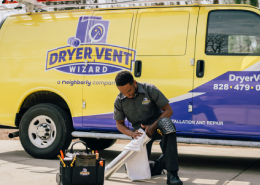
Male Dryer Vent Wizard professional cleaning duct line outside of company van.

Why Businesses Trust Dryer Vent Wizard of West Michigan

Commercial dryer vent rerouting redesigns the exhaust path rather than repairing one section. New routes in West Michigan must account for:

  • Cold exterior walls
  • Snow exposure at roof terminations
  • Seasonal moisture
  • Route length
  • Number of bends
  • Maintenance access
  • Equipment requirements
  • Applicable code and installation requirements

Businesses trust our team to evaluate the full system before shortening, repositioning, or reconfiguring the route. We consider airflow restrictions, recurring lint buildup, building structure, operating demands, and system complexity when selecting appropriate materials and determining whether additional planning is needed.

Our Commercial Dryer Vent Rerouting Process

Here’s what to expect during a commercial dryer vent rerouting appointment:

  • Existing Route Assessment: We inspect the duct path, bends, access points, and exterior termination for routing concerns and moisture exposure.
  • Rerouting Plan: We develop a more direct route based on the building structure, dryer location, manufacturer guidance, and applicable requirements.
  • Airflow and Restriction Check: We identify sharp turns, excessive length, damaged sections, separated joints, and areas where lint or condensation may collect. We also assess whether a booster fan may be appropriate for a long vent run.
  • Professional Reconfiguration: We modify or replace the necessary ductwork using suitable materials and secure joints.
  • Exterior Termination Review: We confirm that the new route reaches an appropriate exterior termination without conditions that may restrict airflow or expose the outlet to obstructions.
  • Final Airflow Check: We evaluate exhaust airflow and explain any remaining maintenance or system concerns.
Why Businesses Trust Dryer Vent Wizard of West Michigan
Risk of fire warning label.
Service You Can Trust!

Let us know how we can help you today.

White Dryer icon.
Still need more information?

Our team of experts are here to answer any questions you may have.

Ada, MI 49301, United States

  • Ada
  • Albion
  • Allegan
  • Allendale
  • Alma
  • Alto
  • Ashley
  • Athens
  • Augusta
  • Bailey
  • Baldwin
  • Bangor
  • Bannister
  • Baroda
  • Barryton
  • Battle Creek
  • Bedford
  • Belmont
  • Benton Harbor
  • Berrien Center
  • Berrien Springs
  • Big Rapids
  • Bitely
  • Bloomingdale
  • Bradley
  • Branch
  • Breckenridge
  • Breedsville
  • Bridgman
  • Brohman
  • Bronson
  • Buchanan
  • Burlington
  • Burnips
  • Burr Oak
  • Byron Center
  • Caledonia
  • Cannonsburg
  • Carson City
  • Casnovia
  • Cassopolis
  • Cedar Lake
  • Cedar Springs
  • Centreville
  • Ceresco
  • Chase
  • Climax
  • Cloverdale
  • Coldwater
  • Coloma
  • Colon
  • Comstock
  • Comstock Park
  • Conklin
  • Constantine
  • Coopersville
  • Coral
  • Covert
  • Crystal
  • Custer
  • Decatur
  • Delton
  • Dorr
  • Douglas
  • Dowagiac
  • Dowling
  • East Leroy
  • Eau Claire
  • Edmore
  • Edwardsburg
  • Elm Hall
  • Elwell
  • Fennville
  • Fenwick
  • Fountain
  • Freeport
  • Fremont
  • Fruitport
  • Fulton
  • Galesburg
  • Galien
  • Glenn
  • Gobles
  • Gowen
  • Grand Haven
  • Grand Junction
  • Grand Rapids
  • Grandville
  • Grant
  • Greenville
  • Hagar Shores
  • Hamilton
  • Harbert
  • Hart
  • Hartford
  • Hastings
  • Hesperia
  • Hickory Corners
  • Holland
  • Holton
  • Homer
  • Hopkins
  • Howard City
  • Hudsonville
  • Idlewild
  • Ithaca
  • Jamestown
  • Jenison
  • Jones
  • Kalamazoo
  • Kendall
  • Kent City
  • Lacota
  • Lake
  • Lake George
  • Lakeside
  • Lakeview
  • Lamont
  • Lawrence
  • Lawton
  • Leonidas
  • Leroy
  • Litchfield
  • Lowell
  • Ludington
  • Marcellus
  • Marne
  • Marshall
  • Martin
  • Mattawan
  • Mcbrides
  • Mears
  • Mecosta
  • Mendon
  • Middleton
  • Middleville
  • Moline
  • Montague
  • Morley
  • Muskegon
  • Nashville
  • Nazareth
  • New Buffalo
  • New Era
  • New Troy
  • Newaygo
  • Niles
  • North Star
  • Nottawa
  • Nunica
  • Oshtemo
  • Otsego
  • Paris
  • Paw Paw
  • Pentwater
  • Perrinton
  • Pierson
  • Plainwell
  • Pompeii
  • Portage
  • Pullman
  • Quincy
  • Ravenna
  • Reed City
  • Remus
  • Richland
  • Riverdale
  • Rockford
  • Rodney
  • Rothbury
  • Saint Joseph
  • Saint Louis
  • Sand Lake
  • Saugatuck
  • Sawyer
  • Schoolcraft
  • Scotts
  • Scottville
  • Shelby
  • Shelbyville
  • Sheridan
  • Sherwood
  • Sidney
  • Six Lakes
  • Sodus
  • South Haven
  • Sparta
  • Spring Lake
  • Stanton
  • Stanwood
  • Stevensville
  • Sturgis
  • Sumner
  • Sylvan Beach
  • Tekonsha
  • Three Oaks
  • Three Rivers
  • Trufant
  • Twin Lake
  • Union
  • Union City
  • Union Pier
  • Vandalia
  • Vestaburg
  • Vicksburg
  • Walhalla
  • Walkerville
  • Watervliet
  • Wayland
  • West Olive
  • Wheeler
  • White Cloud
  • White Pigeon
  • Whitehall
  • Woodland
  • Wyoming
  • Zeeland

Frequently Asked Questions

  • Commercial dryer vents may need rerouting when excessive length, sharp bends, separated joints, or an inefficient termination restrict airflow. Routes through cold or unconditioned spaces may also develop condensation that causes lint to adhere to the duct interior.