Skip to Main Content Skip to Footer Content

Commercial Dryer Vent Inspection in West Michigan

Commercial dryer vent problems can stay hidden until they cause longer drying cycles, excess heat, or unexpected equipment shutdowns. For businesses that rely on dryers every day, restricted airflow or damaged venting can disrupt operations and put additional strain on equipment.

West Michigan conditions can add to these challenges. Snow and ice may obstruct exterior vents, while seasonal moisture and temperature changes can contribute to condensation, lint accumulation, and corrosion. Long or concealed vent routes in multi-unit and commercial properties can make problems even harder to detect.

Dryer Vent Wizard of West Michigan inspects the vent system to identify airflow restrictions, damaged components, and configuration issues. Based on the findings, we recommend the appropriate next step, such as commercial dryer vent cleaning, repair, or rerouting.

Commercial Dryer Vent Inspection in West Michigan
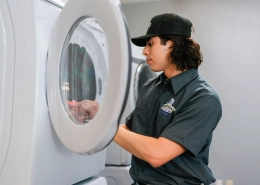
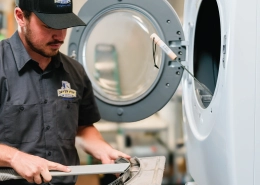
Uniformed dryer vent professional performing commercial dryer vent inspection.

Why Businesses Trust Dryer Vent Wizard of West Michigan

Businesses trust our team to evaluate the full exhaust path, from the dryer connection to the exterior termination. We examine accessible ducts, joints, routing, and airflow for restrictions or damage.

Long or concealed vent routes in older, multi-unit, and commercial properties can hide lint buildup and damaged components. We explain our findings and recommend the appropriate next step based on the system’s condition.

Our Commercial Dryer Vent Inspection Process

Here is what property owners and facility managers can expect during an inspection:

  • System Layout Review: We evaluate the vent route, length, bends, access points, and exterior termination to understand how exhaust travels through the property.
  • Duct Condition Check: We inspect accessible vent sections for loose joints, damaged materials, corrosion from moisture exposure, gaps, and other visible defects that may develop due to seasonal temperature changes.
  • Airflow Evaluation: We assess exhaust airflow for restrictions caused by lint buildup or partial blockages and check for condensation concerns.
  • Exterior Termination Review: We inspect accessible wall or roof outlets for lint buildup, snow or ice obstruction, damaged covers, blocked dampers, and debris accumulation.
  • Clear Inspection Findings: We explain the conditions found and recommend practical next steps based on the system’s layout, usage level, and exposure to local environmental factors.

Complex common-exhaust systems may require additional evaluation or consultation with an appropriate professional.

Why Businesses Trust Dryer Vent Wizard of West Michigan
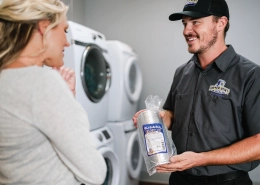
Female business owner speaks with dryer vent cleaner outside of building.
Service You Can Trust!

Let us know how we can help you today.

White Dryer icon.
Still need more information?

Our team of experts are here to answer any questions you may have.

Ada, MI 49301, United States

  • Ada
  • Albion
  • Allegan
  • Allendale
  • Alma
  • Alto
  • Ashley
  • Athens
  • Augusta
  • Bailey
  • Baldwin
  • Bangor
  • Bannister
  • Baroda
  • Barryton
  • Battle Creek
  • Bedford
  • Belmont
  • Benton Harbor
  • Berrien Center
  • Berrien Springs
  • Big Rapids
  • Bitely
  • Bloomingdale
  • Bradley
  • Branch
  • Breckenridge
  • Breedsville
  • Bridgman
  • Brohman
  • Bronson
  • Buchanan
  • Burlington
  • Burnips
  • Burr Oak
  • Byron Center
  • Caledonia
  • Cannonsburg
  • Carson City
  • Casnovia
  • Cassopolis
  • Cedar Lake
  • Cedar Springs
  • Centreville
  • Ceresco
  • Chase
  • Climax
  • Cloverdale
  • Coldwater
  • Coloma
  • Colon
  • Comstock
  • Comstock Park
  • Conklin
  • Constantine
  • Coopersville
  • Coral
  • Covert
  • Crystal
  • Custer
  • Decatur
  • Delton
  • Dorr
  • Douglas
  • Dowagiac
  • Dowling
  • East Leroy
  • Eau Claire
  • Edmore
  • Edwardsburg
  • Elm Hall
  • Elwell
  • Fennville
  • Fenwick
  • Fountain
  • Freeport
  • Fremont
  • Fruitport
  • Fulton
  • Galesburg
  • Galien
  • Glenn
  • Gobles
  • Gowen
  • Grand Haven
  • Grand Junction
  • Grand Rapids
  • Grandville
  • Grant
  • Greenville
  • Hagar Shores
  • Hamilton
  • Harbert
  • Hart
  • Hartford
  • Hastings
  • Hesperia
  • Hickory Corners
  • Holland
  • Holton
  • Homer
  • Hopkins
  • Howard City
  • Hudsonville
  • Idlewild
  • Ithaca
  • Jamestown
  • Jenison
  • Jones
  • Kalamazoo
  • Kendall
  • Kent City
  • Lacota
  • Lake
  • Lake George
  • Lakeside
  • Lakeview
  • Lamont
  • Lawrence
  • Lawton
  • Leonidas
  • Leroy
  • Litchfield
  • Lowell
  • Ludington
  • Marcellus
  • Marne
  • Marshall
  • Martin
  • Mattawan
  • Mcbrides
  • Mears
  • Mecosta
  • Mendon
  • Middleton
  • Middleville
  • Moline
  • Montague
  • Morley
  • Muskegon
  • Nashville
  • Nazareth
  • New Buffalo
  • New Era
  • New Troy
  • Newaygo
  • Niles
  • North Star
  • Nottawa
  • Nunica
  • Oshtemo
  • Otsego
  • Paris
  • Paw Paw
  • Pentwater
  • Perrinton
  • Pierson
  • Plainwell
  • Pompeii
  • Portage
  • Pullman
  • Quincy
  • Ravenna
  • Reed City
  • Remus
  • Richland
  • Riverdale
  • Rockford
  • Rodney
  • Rothbury
  • Saint Joseph
  • Saint Louis
  • Sand Lake
  • Saugatuck
  • Sawyer
  • Schoolcraft
  • Scotts
  • Scottville
  • Shelby
  • Shelbyville
  • Sheridan
  • Sherwood
  • Sidney
  • Six Lakes
  • Sodus
  • South Haven
  • Sparta
  • Spring Lake
  • Stanton
  • Stanwood
  • Stevensville
  • Sturgis
  • Sumner
  • Sylvan Beach
  • Tekonsha
  • Three Oaks
  • Three Rivers
  • Trufant
  • Twin Lake
  • Union
  • Union City
  • Union Pier
  • Vandalia
  • Vestaburg
  • Vicksburg
  • Walhalla
  • Walkerville
  • Watervliet
  • Wayland
  • West Olive
  • Wheeler
  • White Cloud
  • White Pigeon
  • Whitehall
  • Woodland
  • Wyoming
  • Zeeland

Frequently Asked Questions

  • Commercial dryer vent inspections identify airflow restrictions, damaged ductwork, loose joints, and routing problems that may not be visible during basic maintenance. These inspections can be especially important because seasonal conditions may block exterior vents, contribute to condensation, or accelerate wear on vent materials.