



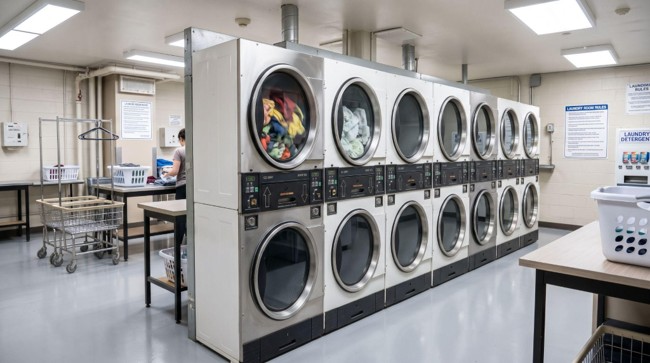
Commercial Dryer Vent Inspection Checklist from the ProsProperty managers should inspect commercial and multi-unit dryer vent systems based on equipment usage and applicable local requirements. It’s recommended to set a schedule with at least annual professional service for most multi-unit properties and more frequent service for high-volume laundry operations. A qualified service professional can help determine the appropriate schedule for each building. A complete dryer vent inspection checklist covers lint screens, transition ducts, concealed vent lines, booster fans, termination points, and gas dryer conditions. Pairing routine staff checks with professional inspections helps reduce fire risk, support code compliance, and keep laundry rooms running.
|
In This Article
- Why Dryer Vent Inspections Belong in Every Property Maintenance Plan
- Your Commercial Dryer Vent Inspection Checklist
- Warning Signs Staff and Residents Should Report
- How Often Should Commercial Dryer Vents Be Inspected?
- How to Schedule Inspections Without Disrupting Residents or Operations
- What Happens When an Inspection Finds a Problem?
- More Information from the Experts
- Keep Every Building on Schedule With Dryer Vent Wizard
- FAQs About Commercial Dryer Vent Inspections
A commercial dryer vent inspection checklist helps property managers catch lint buildup, damaged ductwork, and blocked vent terminations before they lead to tenant complaints, failed inspections, or equipment downtime. The most effective programs pair routine staff checks with scheduled professional inspections of every dryer vent system in the portfolio. Documenting each visit also creates a clear record when owners, boards, or code officials ask for it.
Why Dryer Vent Inspections Belong in Every Property Maintenance Plan
Commercial and multi-unit dryers run far more cycles than a typical household machine. Every load sends lint into the vent line, and the complex vent runs found in larger buildings give that lint more places to settle.
For property managers, a restricted vent also means longer dry times, more equipment wear, and frustrated residents or guests waiting on laundry.
Regular inspections support several priorities at once:
- Fire safety: Reduced risk of lint-related dryer fires in units and common areas.
- Compliance: Alignment with local mechanical codes, fire codes, and HOA or ownership requirements.
- Carbon monoxide risk mitigation: Clear exhaust paths for buildings with gas dryers.
- Moisture control: Proper airflow that helps limit mold and mildew in laundry rooms and wall cavities.
- Throughput: Faster dry times so shared laundry rooms keep up with demand.
- Lower energy costs: Improved airflow that helps dryers run more efficiently.
- Equipment life: Less strain on dryers and fewer appliance service calls.
Your Commercial Dryer Vent Inspection Checklist

Use this checklist to organize routine maintenance observations and professional dryer vent inspections across your properties. Maintenance staff can document visible lint buildup, dryer performance issues, damaged accessible components, and resident complaints without dismantling equipment. Qualified service professionals should handle internal dryer inspections, airflow testing, concealed duct evaluations, booster fan servicing, and rooftop inspections requiring specialized access or equipment.
Lint screens and dryer cabinets
- Lint screens are intact, seated correctly, and free of tears or gaps.
- Lint isn’t collecting around the screen housing, door seal, or floor beneath the dryer.
- The cabinet interior is free of lint near the heating element or burner.
- Dryers reach normal temperature without overheating or shutting off mid-cycle.
Transition ducts and connections
- The transition duct between the dryer and the wall isn’t crushed, kinked, or loose.
- Transition duct material meets the dryer manufacturer’s instructions and local code.
- Joints are secured with foil tape or clamps, not screws that protrude into the airflow and catch lint.
- Dryers sit far enough from the wall to keep the transition duct from bending sharply.
Vent lines and concealed runs
- Airflow at the exterior termination feels strong while the dryer runs on a heated cycle.
- Accessible vent runs show no disconnections, sagging sections, or gaps.
- Vent lines in attics, crawl spaces, and wall cavities show no condensation or water staining.
- A camera inspection confirms concealed runs are clear of lint and debris.
Booster fans
- Booster fans, where installed, power on with the dryer and run without unusual noise.
- Fan housings and blades are free of lint accumulation.
- Pressure switches and indicator lights work as intended.
Termination points and vent covers
- Exterior and rooftop vent covers open fully when the dryer runs and close when it stops.
- Termination points have no screens, which trap lint and restrict airflow.
- Covers are free of lint, bird nests, pest activity, and physical damage.
- Rooftop terminations are clear of snow, leaves, and roofing debris.
- Every vent terminates outdoors, never into an attic, crawl space, garage, or ceiling cavity.
Gas dryers and laundry room conditions
- Gas dryers vent fully outdoors with no sign of exhaust backing up into the room.
- Carbon monoxide alarms near gas laundry equipment are present and working as required by local building code.
- Laundry rooms aren’t unusually hot, humid, or musty during peak use.
- All hoses show no cracks, bulges, or leaks.
For gas dryers, a qualified service professional should always handle disconnecting and reconnecting them. Keep a simple log.
Record the
- Inspection date
- Building and unit number
- Dryer or vent identification
- Observed conditions
- Areas inspected
- Recommended actions
- Priority level
- Responsible party.
Track follow-up work until completed.
Include
- Service date
- Inspection reports
- Pictures.
Consistent documentation helps property managers identify recurring issues, plan maintenance budgets, and maintain records for owners, boards, and applicable inspections.
Some of these checks — especially concealed vent runs and rooftop terminations — require specialized tools and safe roof access. Commercial dryer vent inspections from your local Dryer Vent Wizard® service professional cover the full system, from the lint trap to the termination point.
Warning Signs Staff and Residents Should Report
Problems don’t always wait for a scheduled inspection. Maintenance and front-desk teams should log these issues and make it easy for residents to report them.
- Clothes need more than one cycle to dry.
- The outside of the dryer feels hot to the touch, or the dryer shuts off before the cycle ends.
- A burning smell is noticeable when the dryer runs.
- Lint collects around exterior vent covers or on the roof near terminations.
- Laundry rooms feel hot, humid, or smell musty.
- Vent covers stay open, flap weakly, or show no airflow during a cycle.
- Repeated service calls come from the same unit or laundry room.
A cluster of complaints from one floor or one side of a building often points to a problem in a specific section of the system, such as a blocked rooftop termination. Flag these patterns and notify a service professional as soon as possible. If there are signs of fire or an immediate emergency, evacuate and call emergency services.
How Often Should Commercial Dryer Vents Be Inspected?
The right interval depends on how hard each dryer works. Annual inspection and cleaning is a common baseline for multi-unit residential properties, while high-volume laundry operations often need service more frequently.
| Property type | Typical dryer use | Scheduling consideration |
| Apartments and condos (in-unit dryers) | Moderate; varies by household | Annual inspection, plus follow-up on resident reports |
| Shared on-site laundry rooms | High; many users per machine | More frequent service based on load volume |
| Senior living and assisted living | High; daily linens and personal laundry | Frequent service planned around resident routines |
| Hotels and short-term rentals | Very high; near-constant operation | Frequent service during lower-occupancy periods |
| Fitness centers, salons, and spas | High towel volume | Frequent service tied to usage patterns |
A service professional can recommend a schedule for each building after assessing dryer count, vent configuration, and laundry volume.
How to Schedule Inspections Without Disrupting Residents or Operations
Downtime is often property managers' biggest concern. A well-planned inspection program keeps laundry rooms open and limits how often residents see a maintenance crew.
- Batch units by building or floor so service professionals can work through them in one visit.
- Schedule shared laundry rooms during their lowest-use hours.
- Coordinate rooftop access, keys, and parking before the visit.
- Pair inspections with unit turnover so vacant units are serviced before new residents move in.
- Request written findings for each unit or machine to keep records current.
Dryer Vent Wizard offers scheduled service built around how multi-unit properties operate. Learn more about multi-unit dryer vent cleaning for property managers.
What Happens When an Inspection Finds a Problem?
An inspection is only as useful as the follow-up. Depending on the findings, Dryer Vent Wizard service professionals can address issues across the full dryer vent system:
- Commercial dryer vent cleaning removes lint buildup from vent lines, transition ducts, and terminations.
- Debris and clog removal clears nests, compacted lint, and other blockages.
- Dryer delinting removes lint from inside the dryer cabinet.
- Booster fan cleaning and booster fan installation help maintain airflow in demanding vent configurations.
- Dryer vent repair and dryer vent replacement address crushed, disconnected, or damaged sections.
- Dryer vent rerouting creates a more efficient path when the existing layout restricts airflow.
- Vent cover replacement swaps damaged or screened covers for code-appropriate options.
- Washing machine hose replacement helps reduce the risk of leaks in laundry areas.
- Dryer vent line sanitizing helps address odors in the vent line.
Acting promptly on findings keeps small issues, like a torn vent cover, from becoming larger repairs or extended downtime.
More Information from the Experts
- Learn more: Preventing Dryer Vent Fires explains how lint buildup develops and which habits reduce fire risk.
- Diagnose: Why Is My Dryer Not Drying Clothes? covers the most common cause of long dry times and how to fix it.
- Get professional service: Commercial dryer vent services outlines options for cleaning, repair, installation, and inspection for commercial properties.
Keep Every Building on Schedule With Dryer Vent Wizard
Dryer Vent Wizard has specialized in dryer vent cleaning, inspection, installation, rerouting, service, and repair since 2004. Our locally owned service professionals deliver thorough, multi-unit inspections for apartments, condos, senior living communities, hotels, and other commercial properties, with scheduling designed to minimize downtime.
Every visit includes clear findings you can add to your compliance records. Our work is backed by the Neighborly Done Right Promise®, which ensures we’ll get the job done right. Find your local Dryer Vent Wizard to request an estimate or schedule service for your properties.
AI Disclosure: This article may contain content, images, and/or multimedia generated with the assistance of artificial intelligence (AI). While we make every effort to review, edit, and ensure accuracy, completeness, and alignment with our content standards, we also encourage readers to verify facts, consult trusted professionals, and use their own judgment when making decisions based on their specific situation.
This article is intended for general informational purposes only and may not be applicable to every situation. You are responsible for determining the proper course of action for your home and property. Dryer Vent Wizard is not responsible for any damages that occur as a result of this blog content or your actions. For the most accurate guidance, contact the Dryer Vent Wizard location nearest you for a comprehensive, on-site assessment.
FAQs About Commercial Dryer Vent Inspections
Dryer Vent Wizard is the name homeowners and businesses trust to keep their dryer vent system running optimally and their laundry area safe from potential fire hazards. Our commitment to customer satisfaction also includes applying our industry knowledge and years of experience to answer your questions. Here are answers to the most frequently asked questions about commercial dryer vents and inspections.