



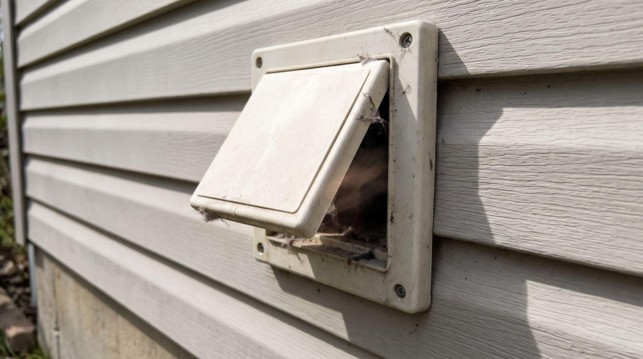
Expert Advice About Dryer Overheating and Vent RestrictionsA dryer that overheats and shuts off may have restricted airflow, and a clogged or damaged dryer vent is one of the most common causes. Built-in safety controls cut the heat when it can’t escape, then may reset once the dryer cools. Professional vent cleaning, inspection, and repair restore airflow so the dryer can finish full cycles safely.
|
In This Article
- Why Does a Dryer Shut Off When It Overheats?
- How a Blocked Dryer Vent Causes Overheating
- Signs the Vent — Not the Dryer — Is the Problem
- What Else Can Make a Dryer Overheat?
- What You Can Safely Check Before Calling a Professional
- How Dryer Vent Wizard Restores Safe Airflow
- More Ways the Experts Can Help
- Dryer Vent Wizard Offers More Guidance For Specific Issues
- Schedule a Dryer Vent Inspection and Cleaning Today
- FAQs About Dryer Overheating and Dryer Vents
A restricted dryer vent is one of the most common reasons a dryer overheats and shuts off mid-cycle. When lint, debris, or a crushed hose blocks the exhaust path, hot, moist air stays trapped inside the dryer, and its safety controls cut the heat to protect the machine. Cleaning or correcting the dryer vent system often restores steady airflow and full drying cycles.
The shutoff is a safety response, not a random glitch, so it’s worth finding the cause before the next load. Never attempt DIY repairs on gas or electrical components. Contact a certified Dryer Vent Wizard® technician for an expert inspection and lasting fix.
Why Does a Dryer Shut Off When It Overheats?
Every dryer relies on a steady stream of air to carry heat and moisture out of the drum. When that airflow slows, heat builds up around the heating element or gas burner faster than it can escape.
Dryers include several heat-sensing safety parts that respond to this buildup:
- Cycling thermostat: Turns the heat on and off to hold the selected temperature.
- High-limit thermostat: Cuts the heat when temperatures climb past a safe range, then resets as the dryer cools.
- Thermal fuse: Acts as a last line of defense and can blow permanently when overheating continues.
- Airflow sensor: Many newer models detect restricted exhaust and display a vent warning or error code.
A dryer that shuts off mid-cycle and restarts after cooling may have an overheating component, but the symptom alone doesn't identify the cause. Restricted vent airflow can contribute to excessive heat, while motor, electrical, and internal appliance problems can also interrupt a cycle. That pattern strongly suggests the system isn’t venting heat properly.
How a Blocked Dryer Vent Causes Overheating
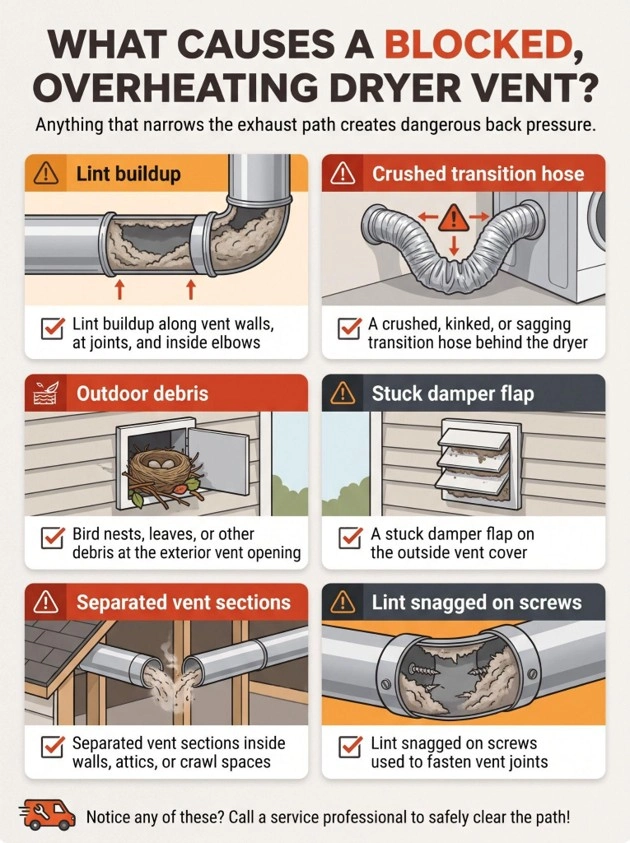
The dryer vent system is the dryer’s exhaust path, so anything that narrows it creates back pressure. Lint is the usual culprit, but it may not be the only one. Our service professionals commonly find these restrictions:
- Lint buildup along vent walls, at joints, and inside elbows
- A crushed, kinked, or sagging transition hose behind the dryer
- Bird nests, leaves, or other debris at the exterior vent opening
- A stuck damper flap on the outside vent cover
- Separated vent sections inside walls, attics, or crawl spaces
- Lint snagged on screws used to fasten vent joints
Why vent length and layout matter
Many building codes based on the International Residential Code limit dryer exhaust ducts to 35 feet. They then subtract 5 feet for every 90-degree turn. A run with several elbows can exceed that limit even when it looks short, unless the dryer manufacturer allows a longer length. The allowable length depends on the fittings, applicable local code, and dryer manufacturer's instructions.
Why cold weather can make it worse
When warm, humid exhaust passes through an unheated attic or exterior wall, moisture can condense inside the vent. Damp lint sticks to the vent walls and hardens, narrowing the opening faster than dry lint.
If your dryer shuts off before the cycle ends, a professional dryer vent inspection can pinpoint where airflow is breaking down. Schedule service from your local Dryer Vent Wizard to find out what’s restricting your system.
Signs the Vent — Not the Dryer — Is the Problem
Overheating can start in the vent or inside the dryer itself. These common symptoms, many of which overlap with a dryer not drying clothes, can help you narrow down the source.
|
Symptom |
What It Often Means |
Suggested Next Step |
|
Dryer stops mid-cycle, then restarts after cooling |
High-limit thermostat tripping from trapped heat |
Have the vent inspected and cleaned by a professional |
|
Clothes still damp after a full cycle |
Weak airflow is holding moisture in the drum |
Check exterior airflow and schedule vent cleaning |
|
Dryer top and clothes feel unusually hot |
Heat isn’t exhausting through the vent |
Avoid back-to-back loads until the vent is checked |
|
Vent warning light or error code |
Airflow sensor detecting a restriction |
Clean the lint screen, then have the vent checked by a professional |
|
Laundry room feels humid or warm |
Exhaust is leaking or backing up |
Schedule service to inspect the transition hose and vent joints |
|
Dryer won’t heat or won’t start |
Thermal fuse may have blown |
Call a professional to repair the dryer and correct vent airflow |
Expert Tip: If your dryer has repeatedly overheated or shut off unexpectedly, stop using it until the cause is identified. For a dryer operating normally, weak airflow at the exterior vent may indicate a restriction. Call a professional before running another load.
What Else Can Make a Dryer Overheat?
If the vent is clear and airflow is strong, the cause may be inside the appliance. Common non-vent causes include:
- A lint screen coated with dryer sheet residue, which can block airflow even when it looks clean
- An overloaded drum that restricts tumbling and air movement
- A failed cycling thermostat that no longer turns the heat off
- A faulty heating element or gas burner component
- Lint packed inside the dryer cabinet or around the blower wheel
Dryer Vent Wizard service professionals can clean the lint screen and dryer lint trap to clear lint from inside the cabinet. Failed thermostats, heating elements, and burner parts call for a qualified appliance repair professional.
Keep one more point in mind. Replacing a blown thermal fuse without correcting the airflow problem rarely solves it for long. The new fuse faces the same trapped heat and can fail again.
Expert Tip: When a service professional replaces a thermal fuse, ask them to check your vent as well.
What You Can Safely Check Before Calling a Professional
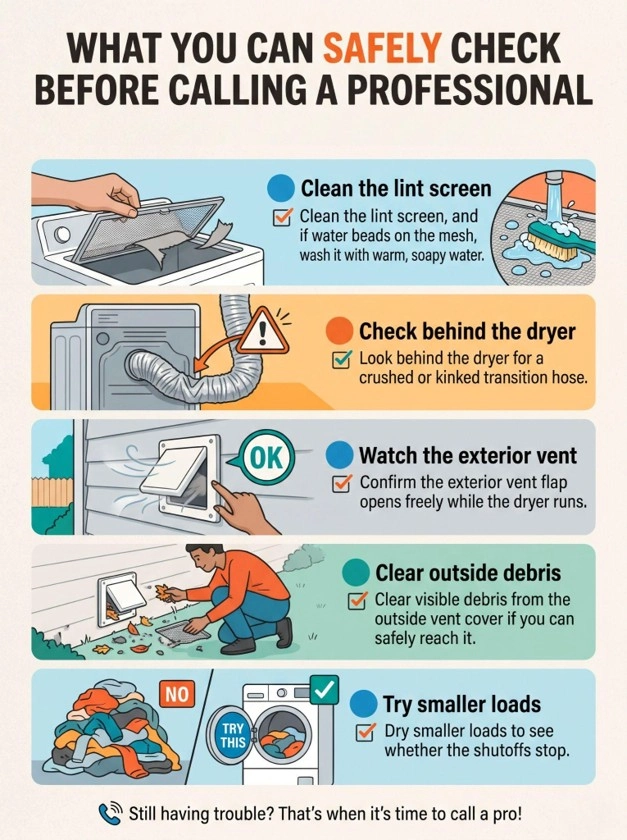
A few quick checks can rule out simple problems.
- Clean the lint screen, and if water beads on the mesh, wash it with warm, soapy water.
- Look behind the dryer for a crushed or kinked transition hose.
- Confirm the exterior vent flap opens freely while the dryer runs.
- Clear visible debris from the outside vent cover if you can safely reach it.
- Dry smaller loads to see whether the shutoffs stop.
Wear a mask and eye protection when handling lint or debris. For gas dryers, a qualified professional should disconnect and reconnect the gas line per local code. Moving a gas dryer to reach the vent can strain the gas line.
Hidden restrictions inside walls, attics, and long vent runs are hard to reach without specialized tools. DIY brushes can also push lint deeper or loosen joints, turning a partial clog into a bigger problem.
Expert Tip: Never take apart vent ducts or access panels yourself. Disrupting the duct system risks improper resealing. Improperly reconnected ducts may leak flammable lint, high humidity, and toxic exhaust into your wall cavities and dramatically increase your risk of a house fire.
How Dryer Vent Wizard Restores Safe Airflow
Dryer Vent Wizard has specialized in dryer vent cleaning, inspection, installation, rerouting, service, and repair since 2004, addressing common dryer vent issues at the source.
Every visit starts with a thorough inspection. Service professionals check dryer vent lines, lint traps, duct joints, transition connections, the exterior termination point, and washer hoses to pinpoint where airflow is failing.
From there, they can recommend the right fix for your home:
- Dryer vent cleaning to remove lint and debris along the entire vent line
- Debris and clog removal for nests, leaves, and compacted lint
- Vent repair and replacement for crushed, separated, or damaged sections
- Vent rerouting to shorten long runs and reduce sharp turns
- Booster fan installation and cleaning where permitted by applicable code for long or complex vent runs that can’t be shortened
- Vent cover replacement when an exterior flap sticks or a screen traps lint
Restoring airflow helps the dryer run as designed. That can mean faster dry times, lower energy costs, longer clothing life, and less strain on heating components. Clear airflow also reduces lint buildup, a key factor in dryer fire risk.
Property managers can also schedule multi-unit and commercial dryer vent cleaning to keep dryer vent systems clear in every building with minimal disruption to residents.
More Ways the Experts Can Help
- Dryer Vent Inspection: See what a professional inspection covers, from the vent line to the termination point.
- Dryer Delinting: Discover how removing hidden lint from deep inside the dryer cabinet and blower wheel prevents internal overheating and fire hazards.
- Dryer Vent Line Sanitizing: when additional vent-line treatment may be recommended and what the service involves to help keep your indoor air fresh and healthy.
Dryer Vent Wizard Offers More Guidance For Specific Issues
- Why Is My Dryer Not Drying Clothes?
- Dryer Not Drying? How To Tell If Your Dryer Vent Is Clogged.
- Dryer Takes Too Long To Dry
- Common Dryer Vent Issues and How to Avoid Them
Schedule a Dryer Vent Inspection and Cleaning Today
A dryer that keeps overheating needs better airflow. Don’t ignore this warning sign. Dryer Vent Wizard service professionals can help identify blockages, damaged ductwork, or vent layout issues. We check, clean, and correct your entire dryer vent system so your dryer can release heat and moisture as designed. Each location is locally owned and operated, backed by a national brand that has specialized in dryer vent safety and efficiency since 2004.
Every service is backed by the Neighborly Done Right Promise®, which ensures you’ll be happy with our work. Find your local Dryer Vent Wizard professional to schedule service today.
AI Disclosure: This article may contain content, images, and/or multimedia generated with the assistance of artificial intelligence (AI). While we make every effort to review, edit, and ensure accuracy, completeness, and alignment with our content standards, we also encourage readers to verify facts, consult trusted professionals, and use their own judgment when making decisions based on their specific situation.
This article is intended for general informational purposes only and may not be applicable to every situation. You are responsible for determining the proper course of action for your home and property. Dryer Vent Wizard is not responsible for any damages that occur as a result of this blog content or your actions. For the most accurate guidance, contact the Dryer Vent Wizard location nearest you for a comprehensive, on-site assessment.